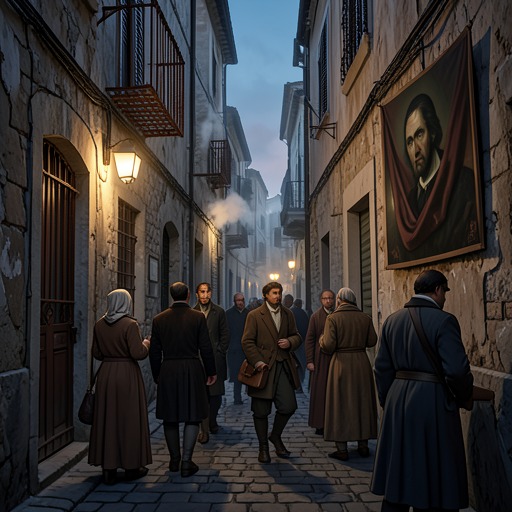
Friar Francis
Much Ado About NothingFriar Francis is the play’s calmest and most consequential religious authority, a figure whose power comes not from rank or force but from patient observation, ethical judgment, and strategic counsel. Present at the church when Claudio publicly rejects Hero, he refuses to let the ceremony’s apparent verdict become the final truth. By distinguishing visible grief from moral guilt, he converts a scene of accusation into an opportunity for protection, investigation, and repair.
Identity and Introduction
Friar Francis enters the church alongside Don Pedro, Don John, Leonato, Claudio, Benedick, Hero, Beatrice, and the attendants, at the moment when Hero’s marriage is supposed to be formalized. Leonato asks him to proceed briefly with the plain form of marriage before recounting the couple’s particular duties, placing the Friar within a sacred and orderly ritual that is about to be violently disrupted. His presence gives the ceremony an institutional and moral frame before the accusation turns that frame against Hero.
The Friar’s authority is immediately tied to his office. When Claudio attempts to control the ceremony through accusation, the Friar does not answer with equal theatricality. His position allows him to remain attentive to what the public spectacle conceals: Hero’s physical response, the difference between shock and confession, and the possibility that the assembled men have mistaken an allegation for proof. His religious identity therefore functions as more than decoration. It supplies an alternative standard of judgment to the honor-based condemnation taking place before the altar.
The Church Accusation and His Reading of Hero
Claudio first challenges Hero directly, asking whether she will give him the daughter Leonato has brought to the marriage. The question appears to preserve the form of consent, but the ceremony has already become coercive: Hero must answer within a hostile public hearing, while Claudio’s suspicion determines how her answer will be interpreted. Don Pedro then asks what man spoke with her between twelve and one, and, when Hero denies speaking with anyone, declares that she is no maiden. The accusation turns the absence of evidence into evidence of guilt.
The Friar’s decisive intervention begins when the other participants react with horror and Leonato’s honor collapses under the charge. Rather than treating Hero’s silence and distress as signs of deception, he asks the assembly to listen to him. He explains that he has remained silent and allowed fortune to take its course, but that his close observation of Hero has shown him a thousand blushes and innocent shames rising into her face. These details matter because they make his judgment evidentiary rather than merely compassionate: he has watched her carefully, and what he sees does not resemble calculated guilt.
His interpretation opposes the men’s rapid public verdict. Claudio and Don Pedro read Hero through the alleged nighttime encounter; the Friar reads her through the involuntary signs of grief, shame, and bewilderment visible in the church. The contrast exposes the danger of a social order that grants a male accusation immediate authority while treating the accused woman’s own answer as confirmation of the accusation. Friar Francis does not simply defend Hero because she is vulnerable; he contests the method by which the community has decided that she is guilty.
Strategy of Apparent Death
Once the accusation has caused Hero to swoon and Leonato has been driven toward despair, the Friar proposes a plan that is both protective and theatrical. He asks Leonato to pause and accept his counsel. The princes, he says, have left Leonato’s daughter for dead; she should be kept secretly indoors for a time, while the household publishes that she has actually died. The proposal transforms the men’s false judgment into an apparent death that can expose the cost of their slander.
This plan is not an escape from the social world but a controlled withdrawal from it. Hero is separated from the public gaze that condemned her, and the announcement of death forces the accusers to encounter consequences without allowing them immediate access to the living woman they have disgraced. The change in status is deliberately unstable: Hero is alive, yet treated as dead; her virtue has been attacked publicly, yet the truth has not been publicly recognized. Friar Francis uses this suspended condition to create time for the community’s certainty to weaken.
Leonato consents because grief has made him unusually susceptible to guidance; he observes that, while he is carried by sorrow, even the smallest thread can lead him. The Friar’s counsel therefore works through a precise recognition of Leonato’s condition. He does not demand heroic composure from a father whose daughter has been shamed. Instead, he offers a narrow course of action that grief can still follow. He then urges immediate execution of the plan, insisting that strange wounds require a strange cure. His language presents the deception as a remedy proportionate to an extraordinary injury, not as an arbitrary trick.
Restoration After Slander
Friar Francis remains part of the household’s later gathering with Leonato, Antonio, Benedick, Beatrice, Margaret, Ursula, and Hero. His presence confirms that the concealment was not an abandonment of Hero but a stage in a larger restoration. When he asks whether he had not told them that she was innocent, the question recalls the judgment he made during the church crisis and places that judgment against the suffering produced by the false accusation.
The difference between innocence and reputation is central to his role. Hero’s innocence exists before the community acknowledges it, while the slander continues to circulate as though it were fact. The Friar’s intervention protects the former until the latter can be corrected. His method thus links private knowledge, public declaration, and ritual repair: first he recognizes Hero’s truth, then he shelters her from further harm, and finally he helps prepare the community to receive the consequences of its mistake.
Narrative and Ethical Significance
Friar Francis is a round and surprisingly active supporting character rather than a one-note emblem of religious virtue. His initial silence gives way to intervention; his observation becomes diagnosis; his diagnosis becomes a plan; and his plan reshapes the plot’s movement from humiliation toward recognition. The decisive surprise is not that he offers pious comfort, but that he responds to a failed wedding with a calculated substitution of death for disappearance, creating a social test that ordinary argument could not have achieved.
His conduct also supplies the play with an alternative to the honor court staged at the altar. Claudio’s charge, Don Pedro’s endorsement, and Leonato’s despair form an improvised tribunal in which accusation outruns examination. The Friar restores a more responsible order of judgment by attending to testimony, bodily signs, timing, and consequence. Yet his remedy still depends on concealment, showing that a damaged public order may require an indirect route before it can recognize the truth it rejected openly.
The symbolic force of his intervention lies in its repeated crossing of boundaries: life is announced as death, disgrace is held apart from innocence, and a broken marriage ceremony becomes the precondition for another attempt at social reintegration. Friar Francis does not erase the violence of the accusation; he gives the community a structure through which that violence can be acknowledged. His importance therefore rests in the combination of compassion and plot-making intelligence: he sees Hero as a person before the men reduce her to a charge, and he acts on that perception before the false judgment becomes irreversible.